Comparing loss-on-ignition, acid decarbonation and combustion elemental analysis for measuring organic carbon concentrations – recommendations for best practice

After testing various lab protocols we have a strong preference for coupling accurate and precise instrumental measurements with combustion pre-treatments to isolate and measure organic carbon. This work was published in Organic Geochemistry.
Quick and cost-effective measurements of organic carbon concentration are fundamental for a variety of environmental projects, but not all methods produce reliable results. Poor quality baseline data could compromise an entire study.

Measuring the total amount of carbon in a sediment sample is usually carried out by an elemental analyser, which makes quick, accurate measurements of carbon and nitrogen. However, sediments can contain carbon in a range of forms – plant matter, mineral-bound organics, microbial biomass, shells, carbonate minerals, and more. Sometimes distinguishing all these sources might be criticial, but often the split between organic and inorganic carbon is sufficient, and important since the organic and inorganic carbon cycles are very different.

For this study, we investigated three ways of measuring the amount of organic and inorganic carbon in a sediment, with a focus on young materials such as saltmarsh carbon.

  1. Loss-on-Ignition: Burning the samples a fixed temperatures to combust the organic matter (at about 500 °C) and decompose inorganic carbon (at 800 – 900 °C). Use the change in mass to estimate the amont of carbon present.
  2. Acid digestion followed by elemental analysis: Removing the inorganic carbon by reacing with acid, and then measuring the remaining organic carbon.
  3. Combustion followed by elemental analysis: Remove organic carbon in the furnace, measuring the remaining inorganic C, calculating the OC lost.

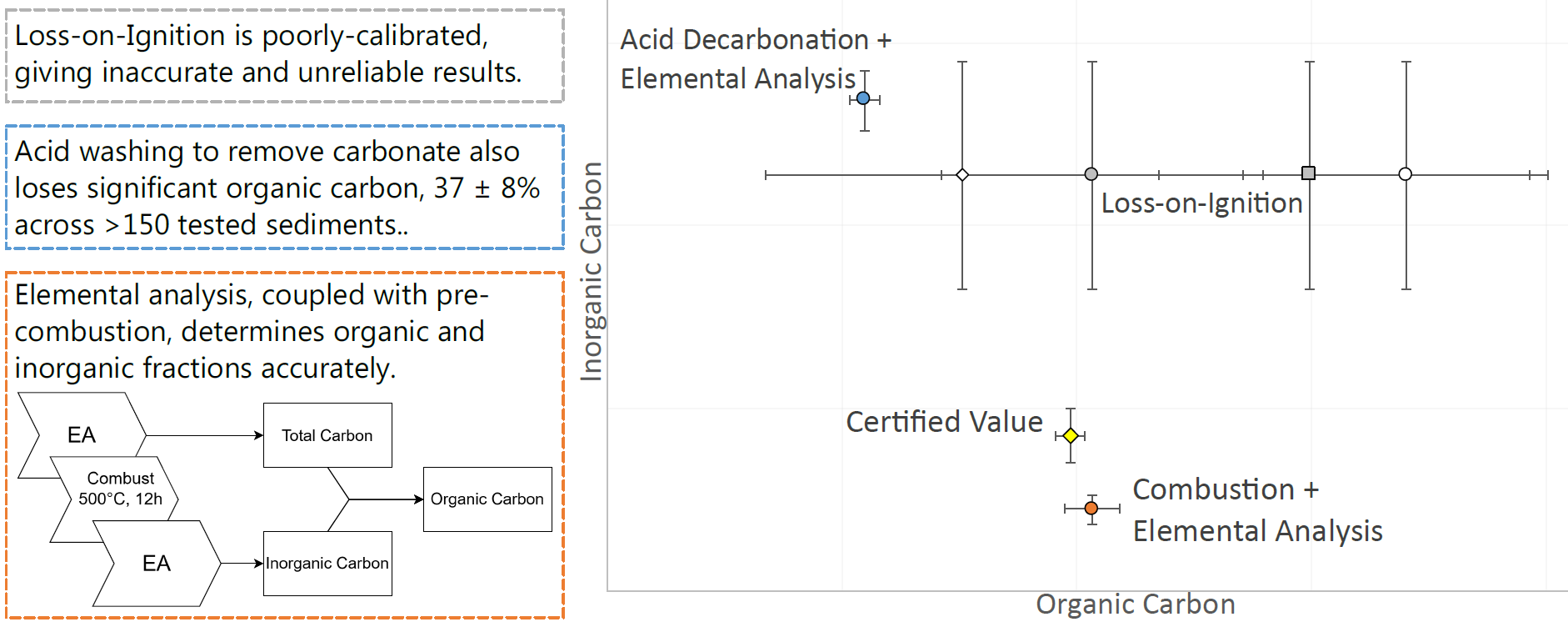
Perhaps the most important finding should not have been a surprise – Loss-on-Ignition relies on combusting organic matter, but wants to measure organic carbon, therefore a conversion between the two is needed. There are lots of conversions in the literature, and they all produce different results. Our testing showed that some common conversions are out by more than 50%, and we cannot recommend using Loss-on-Ignition for current or future work.

We also showed that using acid to remove inorganic carbon also removed up to 40% of the organic carbon, so we would avoid using this technique unless it’s imperative to measure the organic matter directly, for example in stable carbon isotope analysis.

As a final observation, this work was enhanced by contributions from a cohort of undergraduate student co-authors who generated real-world saltmarsh data. For this, I am very grateful.
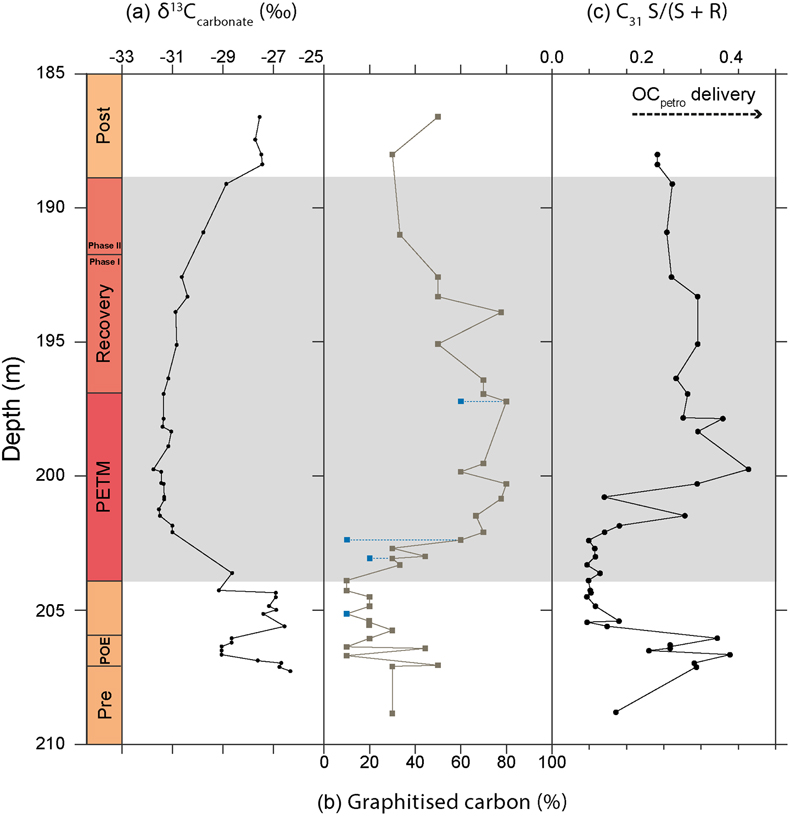
Enhanced petrogenic organic carbon oxidation during the Paleocene-Eocene thermal maximum

This collaboration with the University of Southampton used Raman spectroscopy to investigate cores from an ancient climate event. The study was published in Geochemical Perspectives Letters.

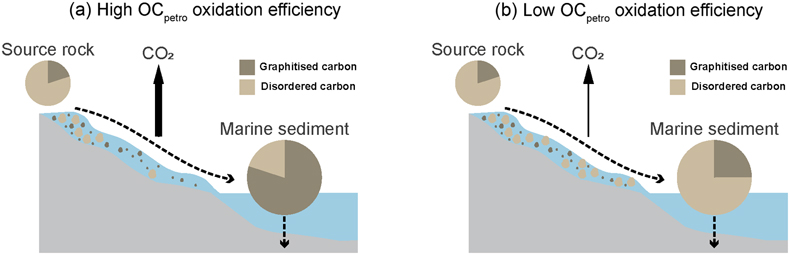
The PETM event caused major, rapid global warming of 4-6 °C, which also released large amounts of carbon into the atmosphere. The climate change associated with the event altered hydrological cycles and may have driven erosion and degradation of petrogenic organic carbon (OCpetro), which may have been a further positive feedback in the PETM climate system.

This is the first study to use Raman spectroscopy to investigate OCpetro oxidation at the PETM. We found that there was an increased contribution of graphite during the PETM, likely caused by intensified physical erosion and enhanced OCpetro oxidation.

In areas where there is a range of OCpetro inputs, both graphitic and disordered, Raman spectroscopy appears to be a very promising tool for investigating past changes in the carbon cycle.

Allochthonous carbon primarily of marine origin in Irish saltmarshes: Novel insights from bacteriohopanepolyol biomarkers

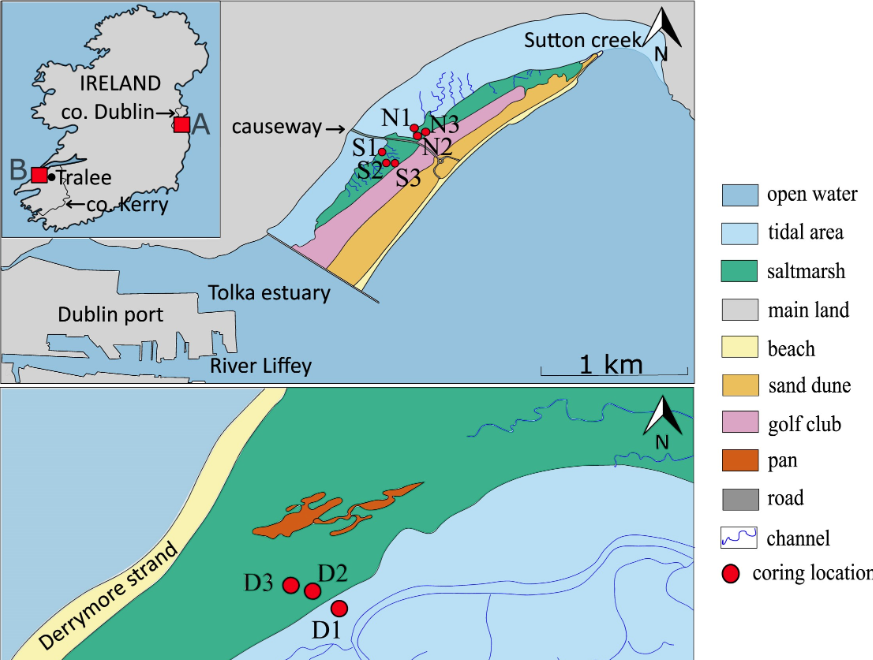
This collaboration with the BlueC project at University College Dublin measured organic carbon and BHP biomarkers in saltmarshes from the East and West coasts of Ireland. The paper is published in Sustainable Microbiology.

A map of sample sites used in this study

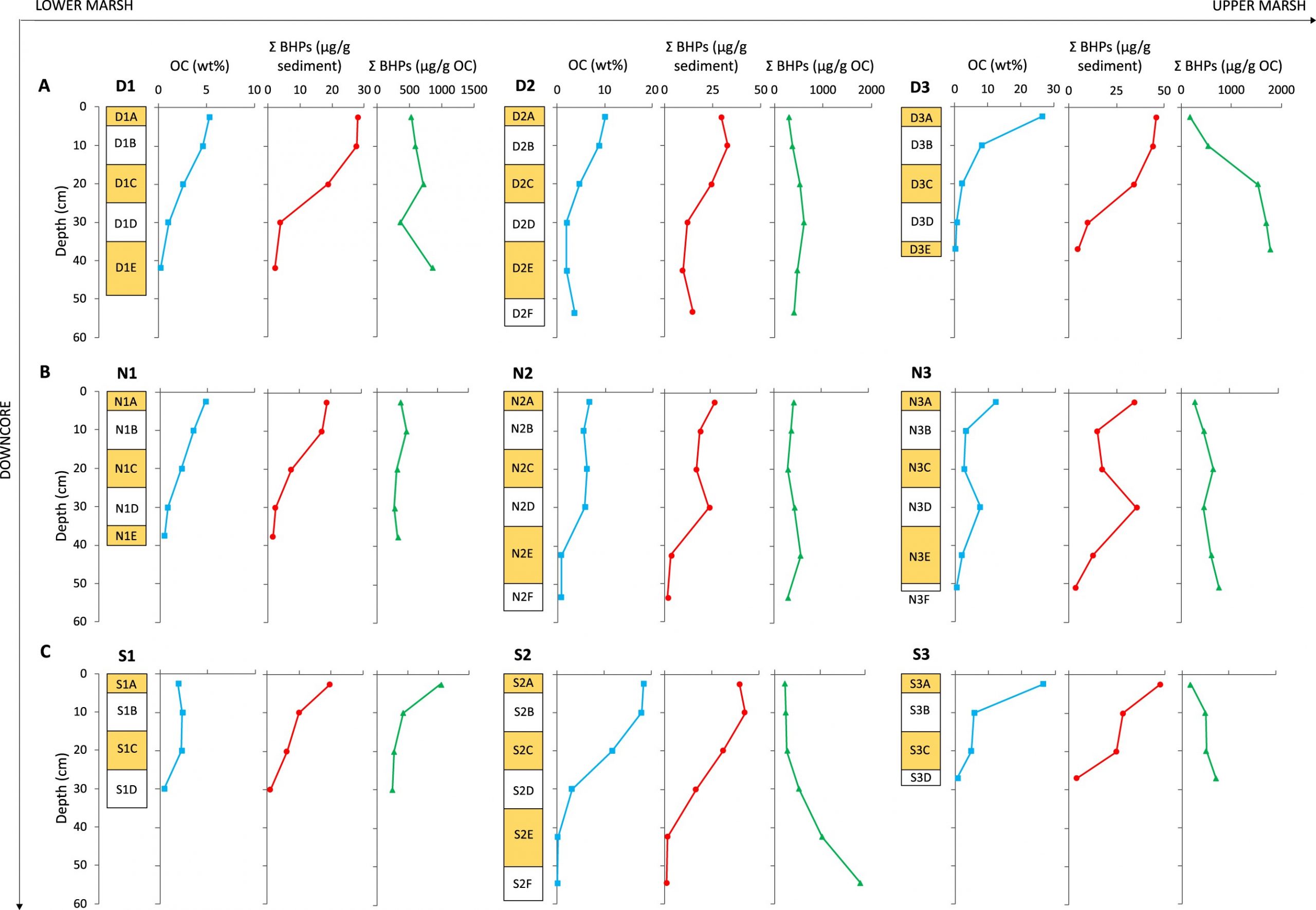
Organic carbon concentrations were high and very variable, from 0.26% up to 26%, a 100 times increase. Concentrations were particularly high at the top of cores from the upper marsh (furthest from the sea). Comparing this to the BHP data showed that these samples were rich in marine organic matter. Terrestrial BHPs were only found in high concentrations at depth in the oldest cores. Therefore, most of the carbon in the saltmarsh sediments has been brought in on the tide, and the influence of tidal sediment supply on saltmarshes is important for their growth and survival.

This is our first study using BHPs to investigate saltmarshes. The oldest, high-marsh sediments had terrestrial BHP signatures, but everywhere else the source appears to be marine.

Past and present bacterial communities in deglaciating northern latitude catchments reveal varied soil carbon sequestration potential

My first PhD student, Saule Akhmetkaliyeva, has published her thesis in Science of the Total Environment. Her study compares organic carbon and bacterial communities across three deglaciating Arctic catchments.

Graphical abstract from Akhmetkaliyeva et al., 2025

After a glacier thaws and retreats, the exposed land is usually quite bare and carbon poor. Saule visited deglaciating sites in Sweden, Iceland and Greenland to measure the amount of carbon present in the sediments and the development of soil bacterial communities over time. She found that bacterial communities change as the soil develops and the organic carbon content rises.

Soil sampling in Tarfala Valley, Sweden

In Sweden, the deglaciation was very recent and the soil very thin, with lowest carbon contents and very few soil biomarkers. Iceland had some very young soils, but also some older moraines with age estimates – older moraines had higher carbon contents and a more developed soil bacterial community. In Greenland, the catchment had been deglaciated for thousands of years and a fully-developed ecosystem was present, with the highest amount of organic carbon, plenty of soil-specific biomarkers, and a stable microbial community.

Older, developed soils in Iceland had higher concentrations of organic carbon and a greater proportion of soil-specific BHP biomarkers

The paper is available, open access, from the journal website and via MMU e-space

Sharing our Standard Operating Procedures

A lot of science is like baking – you follow a procedure (recipe) and generate a batch of data (cake). If the same sample is analysed following the same procedure in two different laboratries, the data generated should be the same. This is not always the case, but standardising the approach across a research community reduces the scope for variability between datasets and allows for comparison between studies.

In a lot of cases, protocols are generated by carefully reading the methods section of a published paper, but publications are often written very concisely and some of the steps taken in the lab could be left out or hard to follow. The step-by-step protocol is less likely to be published, but could be much more useful for those trying to build upon published studies.

To avoid that confusion, I have created a new section of the website dedicated to publishing the latest version of our laboratory standard operating procedures. These are published under a Creative Commons CC-BY 4.0 license so you are allowed – encouraged in fact – to use, adapt, improve and share these protocols.

I also welcome feedback regarding the protocols. Comments are enabled on each one and you are welcome to highlight steps that are unclear or could be improved.